Signed in as:
filler@godaddy.com

Smart Cities and Artificial Intelligence: Convergent Systems for Planning, Design, and Operations, presents an integrated perspective on how cities are evolving as intelligent ecosystems shaped by the convergence of human, technological, and environmental systems. Drawing on developments in machine learning, neural networks, geospatial intelligence, data analytics and visualization, sensors, and smart connected objects, the book explains how these elements combine to form a new urban collective intelligence. By framing cities as real-time, adaptive, living systems, and by introducing tools such as generative design and living lab models, the book equips readers with the conceptual and practical foundation needed to plan, design, and operate next-generation smart cities. Adopting a multidisciplinary and systems-based approach, it provides a holistic understanding of smart cities through interconnected theory, planning and design methodologies, system architecture, and applied smart city functions, all aimed at enabling more liveable, sustainable, and self-regulating urban environments.
The second edition introduces a new section in each chapter framed as reflections and projections, offering insights across the ten-year window from 2020, when the first edition was published, through 2030. These additions align the book with recent developments in AI and urban technologies and include an expanded comparison of global smart cities in the City DNA section, examining how different cities evolve, adopt technology, and shape distinctive global identities and competitive positions. Additional updates include new material on Digital Twins and the Metaverse as emerging extensions of the smart city operating system, select new use cases, refreshed references, and an expanded glossary to improve clarity and accessibility. Together, these enhancements ensure that the book remains current and useful for practitioners, policymakers, researchers, and educators shaping the future of urban intelligence.

In the next stage of convergence evolution, AI will help humanity develop a new form of collective intelligence—an essential interface between people and the natural world. Over the coming decades, a hyper-accelerated fusion of human and machine capabilities will redefine how we live on the planet, shaping a deeper, more adaptive relationship with Earth’s ecosystems.
Convergence Theory provides the conceptual foundation for understanding how cities evolve by integrating human, natural, and technological systems over time. Drawing on diverse strands of convergence—from science and society to media, knowledge, organizations, and the 4IR—the theory frames the smart city as a “convergent socio-cyber-physical complex” capable of adaptive, self-regulating behavior. By reinterpreting Convergence Theory for initial value problems, the framework introduces the concept of Net Present Potential, a method for assessing a city’s current physical, cultural, and technological conditions to predict its evolutionary trajectory. This approach helps cities identify how technology should be integrated across planning, design, and operations, supporting a continuous process of adaptation, alignment, and intelligent transformation.

This model illustrates how cities, smart technologies, and society converge to form a unified ecosystem where academic research, industry innovation, and community participation co-create the future urban environment. At the intersection of physical space (urban design and infrastructure), digital space (AI, IoT, UX, and the Metaverse), and social space (co-design and citizen engagement), the city becomes a living lab—a dynamic environment for experimentation, feedback, and continuous adaptation.

This vocabulary map reflects the foundations of Smart Cities and AI Convergence — bringing together ideas like City as Living Organism, Collective Intelligence, City DNA, Convergence, Flow, Cybernetics, and Homeostasis, alongside technologies such as AI, IoT, Machine Learning, Digital Twin, Smart Connected Objects, and Data Analytics, combined with human-centered concepts like User Experience, Co-Design, Community Engagement, and Urban Interface. Together, they illustrate the multidisciplinary ecosystem that shapes intelligent, adaptive, next-generation cities.
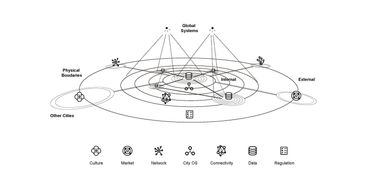

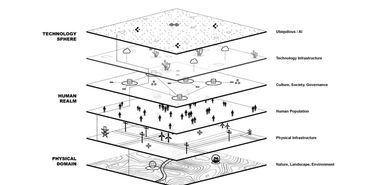
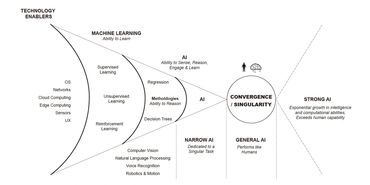
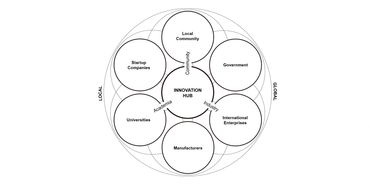
Info System represents a conceptual and technical visual ecosystem encompassing an open-ended spectrum of the converging human-bio-technical systems and processes explained throughout the three sections of the book. In a sense, the book itself has been designed as a form of operating system information architecture with multiple illustrations and a glossary of terms to explain the theories, methods, and application of artificial intelligence and smart cities. The Info System icons are presented as a flexible, adaptable lexicon structure to assist in the understanding of the system's complexity, its components, and the many functions and attributes.

Smart connected objects are everyday physical assets embedded with sensors, processors, and network communication capabilities that allow them to collect data, respond to environmental conditions, and interact with other devices and systems in real time. These objects range from simple environmental sensors and wearables to complex infrastructure elements such as intelligent streetlights, adaptive building systems, and autonomous mobility devices. By linking physical artifacts to digital networks, smart connected objects create continuous feedback loops that support monitoring, prediction, optimization, and automated decision-making across the urban environment. Together, they form the foundational layer of the smart city’s distributed intelligence.

Smart Cities and Artificial Intelligence offers a comprehensive view of how cities are evolving into smart ecosystems shaped by the convergence of human, technological, and natural systems. The first edition introduced a groundbreaking perspective: that this evolution is part of a century-long continuum...